


Molten Trails
Location: Bend, OR
Project Partners
Engineering: HWA

The work is largely organized as a grading study layered over the existing trail footprint, undertaken in close coordination with HWA, who led the detailed regrading and routing design. Together, the team explored alignment options that would bring slopes, landings, and cross‑grades into compliance while maintaining a coherent sequence of spaces and viewpoints. Realignment decisions intentionally balance technical performance with experiential quality, bending routes to frame long vistas across the lava, reveal the scale and texture of the flow, and connect to interpretive stops in a way that unfolds the site gradually for visitors. Within this collaborative framework, landscape architecture input focuses on selecting routing paths that offer comfortable pacing, clear sightlines, and an intuitive narrative progression through the lava field.
Given the harsh exposure of the site, wayfinding and rest opportunities are treated as essential components of visitor experience. Waypoints and pause points are deliberately spaced along accessible segments to provide opportunities for rest and reorientation, particularly for users who may need frequent breaks in the hot, shadeless environment. Bench concepts and locations were studied to align with the overall circulation and to offer both physical relief and focused moments to engage with views and interpretive content, while limiting incentive for off‑trail wandering across fragile surfaces.
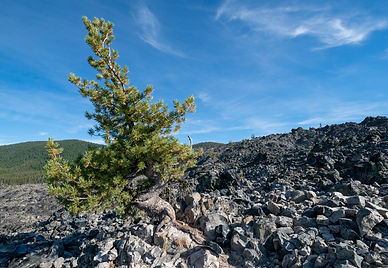

Molten Trails at Newberry National Volcanic Monument focuses on revitalizing an aging interpretive trail system across a sensitive lava landscape while quietly elevating accessibility, user comfort, and resource protection in a way that appears almost invisible to the casual visitor. The project sits within the lava fields below Newberry Crater on land managed by the U.S. Forest Service, where legacy trails cross rough black rock, sparse vegetation, and fully exposed high‑desert conditions.

The Molten Trails segment addressed by Szabo Landscape Architecture occupies a portion of the lava field where an older visitor trail system provided access to viewpoints and interpretive stops but had significantly deteriorated over time. The original construction, completed many years ago, no longer met current expectations for accessibility, particularly in terms of grade, cross‑slope, and surface continuity, and several sections were physically failing. Some portions of the existing alignment were already close to universal access requirements and could be retained with targeted grading adjustments and detail refinements, while others required more substantial rerouting and reconstruction to meet contemporary standards. This combination of structural degradation, accessibility deficiencies, and the sensitivity of the lava substrate created a clear need for a carefully calibrated, minimal‑disturbance intervention.
Szabo Landscape Architecture supported he U.S. Forest Service and HWA Engineering in bringing an existing interpretive trail up to current accessibility benchmarks while preserving the immersive volcanic character of the site. The core intent is to extend accessible experiences deeper into the lava field so that visitors using mobility devices or seeking gentle, predictable grades can safely reach key views and interpretive moments. SZABO’s contribution centers on a grading‑led design study, refinement of trail alignments, and detailed input on wayfinding, seating, and edge conditions, ensuring that functional upgrades read as a natural evolution of the terrain.
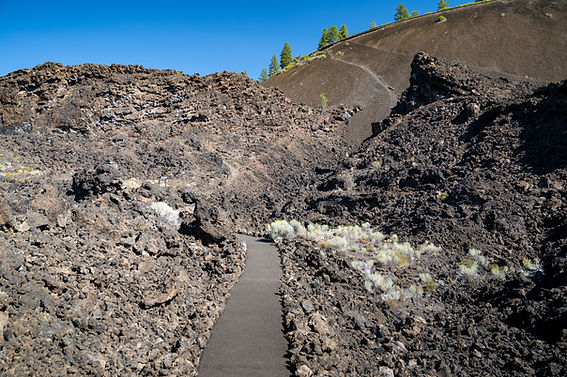

A defining rationale for the project is the pursuit of functional improvements with a nearly non‑existent apparent footprint in the landscape. Regrading strategies begin with a close reading of the natural grades of adjacent lava surfaces, using those as reference conditions for reconstructed slopes to avoid unnatural breaks or engineered forms that would visually stand out. Trail edges and rebuilt areas draw directly from the existing rock palette. Natural rock sizes and diameters were documented and then matched so that color, texture, and grain remain consistent underfoot and alongside the path. Where windswept soils have accumulated between rocks, planting pockets naturally form, capturing limited moisture and supporting scattered native plants. Reference areas that remain untouched show that these vegetated pockets occupy only a small percentage of the lava field, and the remediation strategy mirrors that limited distribution and pattern. Similar planting pockets were dispersed through the work area to preserve the impression of a sparsely vegetated, but determined, environment.
By coupling accessibility upgrades with a light‑touch material and grading approach, the Molten Trails project advances visitor inclusion while reinforcing the volcanic character and ecological fragility of the Newberry landscape. The work supports broader efforts within the Monument to provide barrier‑free experiences, ensuring that more visitors can safely experience the scale, heat, and raw beauty of the lava flows. At the same time, the project exemplifies Szabo Landscape Architecture’s commitment to interventions that are technically rigorous yet visually restrained, embedding improved performance and comfort within a trail system that feels as though it has always been part of the lava field.